
Best AI video clippers for turning long videos into Shorts
Compare OpusClip, Descript and Riverside by workflow, then check context, framing, captions and the real cost of approved clips.
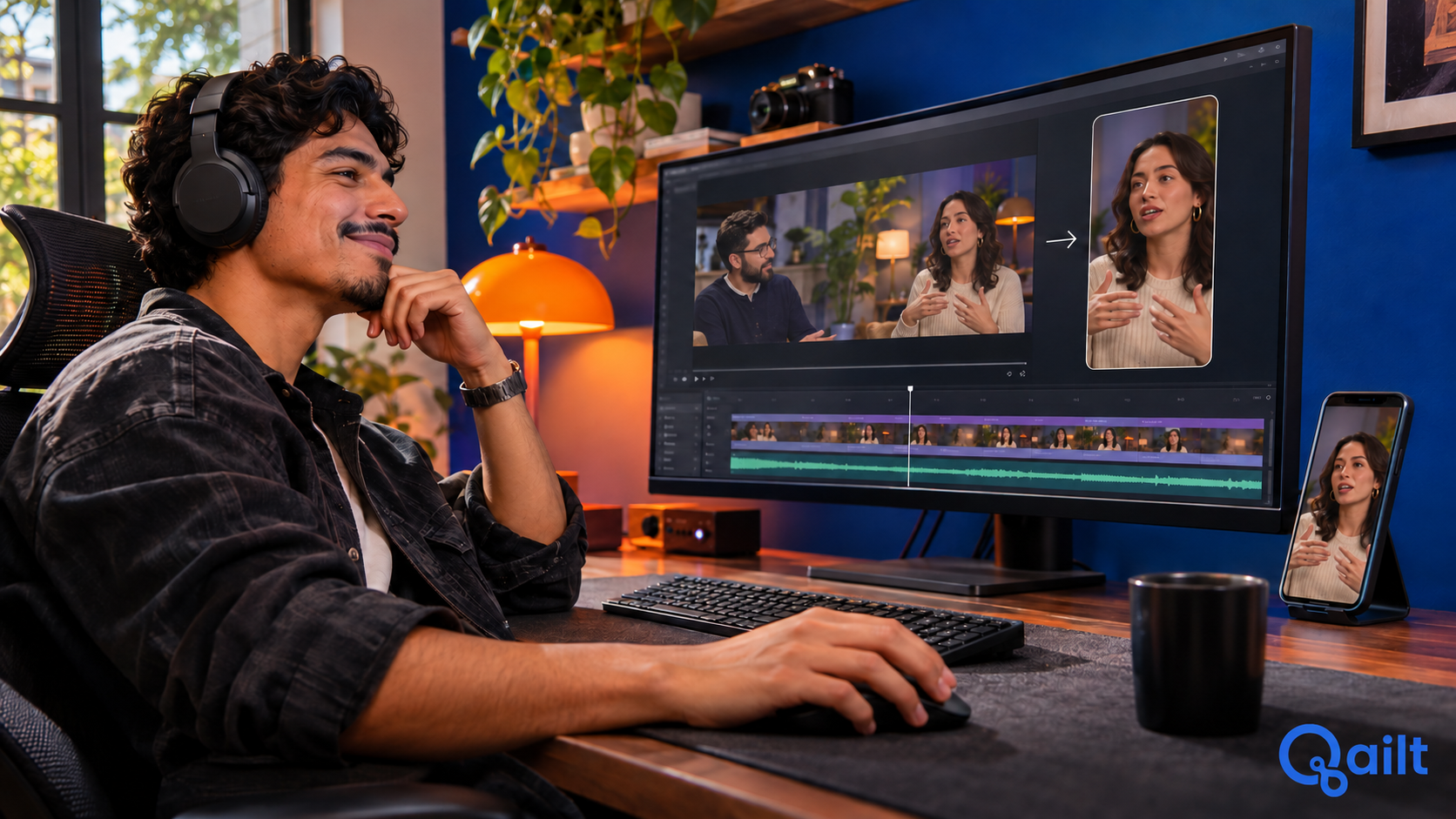
To turn a long video into Shorts, choose by editing workflow first: OpusClip for finding moments from a prompt, Descript for working through a transcript, and Riverside for keeping recording and clip production in one place. No automatic score guarantees views. The right tool helps you publish an understandable, faithful and properly framed excerpt.
Documented features checked on 13 November 2026. This is an editorial assessment, not a hands-on benchmark: we did not process the same video through these three services. The exercise below is a repeatable review protocol for readers. Check prices, credits and export limits in the plan actually available to you.
A good Short is more than a shorter video
Viewers should understand one idea without watching the previous twenty minutes. A tool may identify an energetic sentence but cut the qualification that gives it meaning. It may also track a speaker's face while the important information is in an on-screen demonstration. Your goal is a self-contained excerpt, not simply a vertical file.
This guide starts from an existing recording. To make a video from written material, use our guide to turning a blog post into video instead. Translating subtitles and dubbing are separate stages too: first approve the edit in its original language.
Which tool fits your situation?
OpusClip: find specific moments
OpusClip's ClipAnything describes prompt-based clip selection using visual and audio cues, plus reframing into several aspect ratios. We would shortlist it for quickly examining suggestions around a specific theme. Context remains the critical check: a passage matching your requested word is not necessarily a complete answer. Review the original sequence before accepting the final cut.
Descript: revise the edit through its transcript
Descript's official workflow combines a video-synchronised transcript, passage search and clip creation. We would favour it when choosing and adjusting the wording comes before visual presentation. That suits a dense interview or narrated demonstration; the transcript still needs correction when names, numbers or negative statements are recognised incorrectly.
Riverside: stay in one production workflow
Riverside Magic Clips offers highlight selection, duration, layout and framing adjustments, plus customisable captions. We would examine it first when recording and editing already happen in Riverside. Avoiding transfers can simplify production, but convenience does not replace checking the exported file. Marketing claims about virality are not results we have measured.
Prepare your video before comparing tools
Choose a recording you have the rights to use and retain the source file. For the trial, use an interview or tutorial containing a complete idea, an important qualification and a moment where framing matters. A fixed talking-head video will not expose the same weaknesses as a screen share or product demonstration.
Write the same brief for every candidate: intended audience, topic, number of excerpts and target duration. Asking for three passages of 30 to 60 seconds, for example, is a test choice, not a universal YouTube rule. A platform's maximum permitted length is not an editorial target: stop when the idea is complete.
Suggest three self-contained excerpts about preparing a product demonstration. Keep the question if it is needed to understand the answer. Preserve conditions, qualifications and numbers. Add no promise that is absent from the original. For each suggestion, give the passage boundaries and explain your selection.
Worked exercise: do not cut the condition
This invented scenario is for practising review, not a result attributed to any provider. In an interview, the speaker says: “We halved preparation time in this small trial. But only for files that were already complete. The others still need a manual check.” Consider three proposed edits.
- A: “We halved preparation time.” Short, but it removes the scope and condition. Reject it.
- B: the complete statement, preceded by “When did this work?” The excerpt is self-contained and keeps its limitations. It is a candidate for approval.
- C: the complete statement, with the title “Cut all your turnaround times in half”. The video preserves the words, but the title distorts them. Correct the title before publishing.
B is the right answer, subject to the remaining visual and audio checks. C becomes acceptable with a title such as “What accelerated our small trial”. A does not become faithful simply by adding music or captions: restore the context. This exercise shows why an engagement score cannot replace an editorial decision.
Review in three passes
- Listen without watching. Can you understand the subject? Are sentences complete? Does a cut remove a negative or change what an answer means?
- Watch without sound. Do captions convey the important words? Are numbers correct? Does text cover the demonstration?
- Watch the exported file on a phone. Check readability, framing changes and the clip's ending. The editor preview is not enough.
Return to the source whenever a sentence is ambiguous. An isolated “yes” is not a useful answer if the question has disappeared. Likewise, a phrase such as “this one” loses its meaning when the object has been cropped out.
Framing: the face is not always the subject
In an interview, faces and reactions may matter most. In a software tutorial, the button, result or cursor needs to remain visible. In a physical demonstration, keep the object and essential gestures. If a passage does not work in a tight vertical crop, use a layout that preserves the information or select another excerpt.
Position captions with enough space around important elements. Check the beginning, middle and each speaker change. One correctly framed still does not prove that tracking stays accurate throughout the sequence. Avoid adding many animations when understanding the clip already requires reading a screen.
What does a publishable excerpt actually cost?
Check imported or analysed minutes, credits, exports, watermarks, resolution and correction options for the plan. Do not compare only the number of generated clips. A hundred suggestions needing a complete re-edit are not a hundred finished pieces of content.
A hypothetical example: a session costs €6 and produces twelve excerpts, four of which pass review. Generation costs €1.50 per accepted excerpt. If correcting each one takes ten minutes, add forty minutes of work. Compare two tools on that total, then on how faithfully they preserve the original. None of these figures describes the services' actual pricing or performance.
Publication checklist
- The topic makes sense without the long video.
- Essential questions, conditions and qualifications remain intact.
- The title and captions do not exaggerate the message.
- Relevant faces, objects and demonstrations stay visible.
- Rights to images, voices and music have been checked for this use.
- The final file has been watched from start to finish, and the source and editing decisions are retained.
Frequently asked questions
Does an AI clipper guarantee more views?
No. Our selection does not measure audience or engagement. Treat suggestions as a discovery aid, then compare your actual results without confusing correlation with the software's effect.
Should you translate before cutting?
We recommend approving the original excerpt's meaning and boundaries first. That avoids correcting several language versions of an edit that will be rejected. Review the translation in its own context afterwards.
Where should you start?
Try two workflows on the same source and keep no more than three excerpts for the initial review. For more on transcript-based editing, see the Descript tool page and our tutorial on removing filler words. Do not automatically remove every pause: some make the message clearer.
Put it into practice

Related tools

Descript
Descript records and edits podcasts, interviews, and videos using a transcript synchronized with the audio and video tracks.
Read next

Top 10 AI tools for social media managers
Ten AI tools for social media workflows: visuals, video, writing and planning. Compare approval, formats and real campaign costs without duplicate subscriptions.
Top 10 AI tools for a podcast production workflow
Ten AI tools for podcast preparation, editing, transcription and promotion. Build a minimal workflow with audio, quotation and cost checks.

CapCut alternatives for PC: editing, captions and exports
Clipchamp, Shotcut or Resolve: test your files, vertical layouts, captions and export limits before switching from CapCut on a PC.