
Remove audio noise with AI without damaging the voice
Compare Adobe Podcast, Descript and Auphonic for audio cleanup. Preserve useful sounds and check voice quality with a repeatable listening exercise.
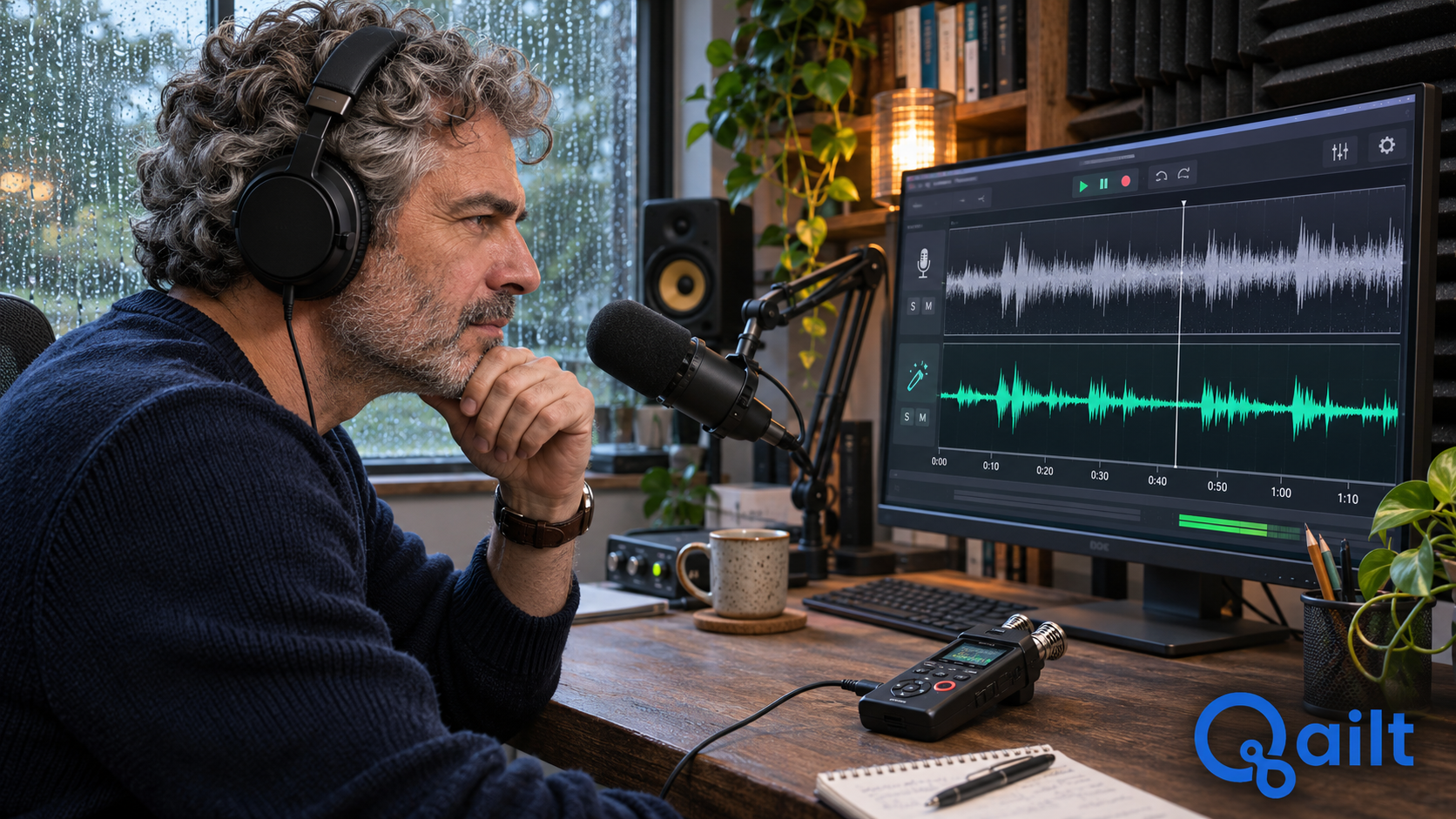
The best tool for removing recording noise improves intelligibility without damaging the voice or deleting useful sound. Adobe Podcast Enhance Speech is worth trying for a quick voice cleanup; Descript makes sense if you already edit there; Auphonic deserves consideration when a recurring production needs separate decisions about speech, music and ambience.
Do not choose solely by which sample sounds quietest. A metallic voice, clipped word endings or missing music may be more distracting than mild hiss. This comparison uses documented capabilities and an original listening method you can apply yourself. It does not claim a QAILT listening test or measured quality score.
Identify what should be removed
List the problems first: constant hiss, a fan, traffic, room reverberation, handling noise or level differences between speakers. They do not necessarily need the same treatment. Someone recorded far from a microphone may remain difficult to understand even after background noise disappears.
Also define the sounds to retain. Outdoor ambience can establish the setting of an interview. Music in a musical demonstration is not noise. An alert in a tutorial may convey useful information. Decide this before selecting voice isolation, rather than discovering afterwards that the treatment removed part of the content.
Choose for your situation
| Need | Option to consider | Priority check |
|---|---|---|
| Occasional voice cleanup | Adobe Podcast Enhance Speech | Natural voice and account processing limits |
| Text and audio editing in one project | Descript Studio Sound | Intensity and artefacts on quieter words |
| Recurring episodes with music and ambience | Auphonic | Mode selection and retained sounds |
| Unintelligible speech that can be recorded again | A new recording where possible | Source clarity before processing |
Adobe Podcast: start with a representative voice sample
Adobe describes Enhance Speech as a noise-reduction and speech-enhancement tool. Processing options and allowances depend on the offer. Before uploading a long video, check supported formats and your account’s actual remaining allowance, as the Adobe Podcast FAQ advises.
Try a section containing the file’s difficulties, not just its clearest sentence. Include quiet speech, a pause and a noisy passage. If processing works only on the easy moments, the rest will still need attention. Retain the original recording and a separate processed copy so you can compare without overwriting the source. A sample that fails your acceptance criteria is useful evidence not to process the whole file yet.
Descript: convenient in an existing editing workflow
Descript Studio Sound offers an intensity control. The vendor acknowledges that reconstruction can sometimes make the voice sound artificial and suggests reducing the effect. That is a practical reason to compare moderate and stronger settings rather than automatically using the maximum.
If you already use Descript for editing, keeping cleanup inside the project can simplify corrections. Distinguish acoustic cleanup from changing speech: removing hesitations or regenerating a sentence is a separate decision. A request to improve audibility does not mean the speaker’s words should be changed.
After editing, listen carefully at joins. Two differently processed clips can make a speaker seem to switch microphones or rooms abruptly. Aim for comfortable continuity rather than eliminating every trace of noise from each fragment. Keep treatment choices understandable to anyone who will reopen the project.
Auphonic: decide which sounds must remain
Auphonic distinguishes dynamic denoising from speech isolation. The former aims to retain speech and music, while speech isolation retains speech only. This matters for a podcast with background music or a report where ambience is intentional.
The production documentation describes reusable presets and segment-level adjustments, including turning denoising off for particular sections. For a series, begin with consistent settings and then handle exceptions. A preset suited to a quiet room should not be assumed suitable for a car interview.
Keep a short statement of the intended result, such as “clearer speech, music retained”. It helps the next editor understand why some background sound remains. The decision is editorial as well as technical: a completely isolated voice may be appropriate for narration but less suitable when the location itself is part of the story.
A two-minute listening protocol
This is a suggested exercise, not a vendor test result. Record your own voice in a short sequence with five seconds of room sound, a normal sentence, a quieter sentence and a phrase containing several consonants. Use fictional wording: “The final file is ready. It costs fifteen euros, not fifty. Please check track six.”
Do not deliberately create unsafe sound levels. Moderate existing household noise is sufficient to observe a processing effect. If you add test music, use material you have rights to use and note whether you intend to keep or remove it.
Create a light and a stronger version where the tool permits. Compare the same passages at similar perceived loudness: a louder output can seem better without being more faithful. Alternate with the original and record the defects you actually hear rather than inventing a scientific score.
| Passage | Question |
|---|---|
| Quiet sentence | Are all words still audible? |
| “Fifteen, not fifty” | Are the number and negative preserved clearly? |
| Consonants and word endings | Is anything metallic or cut off? |
| Pause | Does ambience disappear and return abruptly? |
| Optional music | Does it match the intended outcome? |
When to reduce the effect or record again
Use lighter processing if the voice sounds transformed or syllables become harder to understand. When important information is unintelligible in the source, do not treat a plausible reconstruction as proof of what was said. Ask for a new take or clarification from the speaker where possible.
For recordings retained as references or evidence, keep the original intact and label processed copies clearly. This guide concerns listening quality, not certification of authenticity or restoration accuracy. A cleaner sound and a reliable record of the original speech are different requirements.
Preparing the next recording can cost less
Before the next take, reduce avoidable noise, keep microphone placement stable and listen to a short recording. Checking at the start avoids discovering a problem across an entire episode. If several people speak, check each person: one clear voice does not validate the whole conversation.
Once the audio version is approved, prepare its transcript and subtitles. Our guide to French-English subtitle translation explains meaning and timing checks. Do not let a late edit invalidate previously exported tracks. Keep the approved recording, final video and subtitle version names aligned.
Frequently asked questions
Should the result be completely silent between words?
No. The best compromise keeps speech intelligible and natural alongside necessary sound. Mild consistent ambience may be preferable to aggressive processing that pumps between words. Judge the whole passage, not an isolated silent gap.
Can one setting work everywhere?
A shared starting point is useful, not a universal rule. Rooms, microphones and speakers change. Inspect different passages before processing an entire batch, and save a note when an exception needs another setting.
Which tool is most economical?
Start with one already available in your workflow. Compare the cost of processing the full file, available exports and correction time. No subscription replaces listening to the final output. If re-recording a short passage is faster and clearer than repeated repair attempts, that may be the better production decision.
Related tools

Descript
Descript records and edits podcasts, interviews, and videos using a transcript synchronized with the audio and video tracks.
Read next

Top 10 AI tools for social media managers
Ten AI tools for social media workflows: visuals, video, writing and planning. Compare approval, formats and real campaign costs without duplicate subscriptions.
Top 10 AI tools for a podcast production workflow
Ten AI tools for podcast preparation, editing, transcription and promotion. Build a minimal workflow with audio, quotation and cost checks.

CapCut alternatives for PC: editing, captions and exports
Clipchamp, Shotcut or Resolve: test your files, vertical layouts, captions and export limits before switching from CapCut on a PC.