
Open-source ElevenLabs alternatives: voices, licensing and setup
Kokoro, Piper or Chatterbox: compare weights, voice licences, setup and operating costs before replacing ElevenLabs with an open alternative.
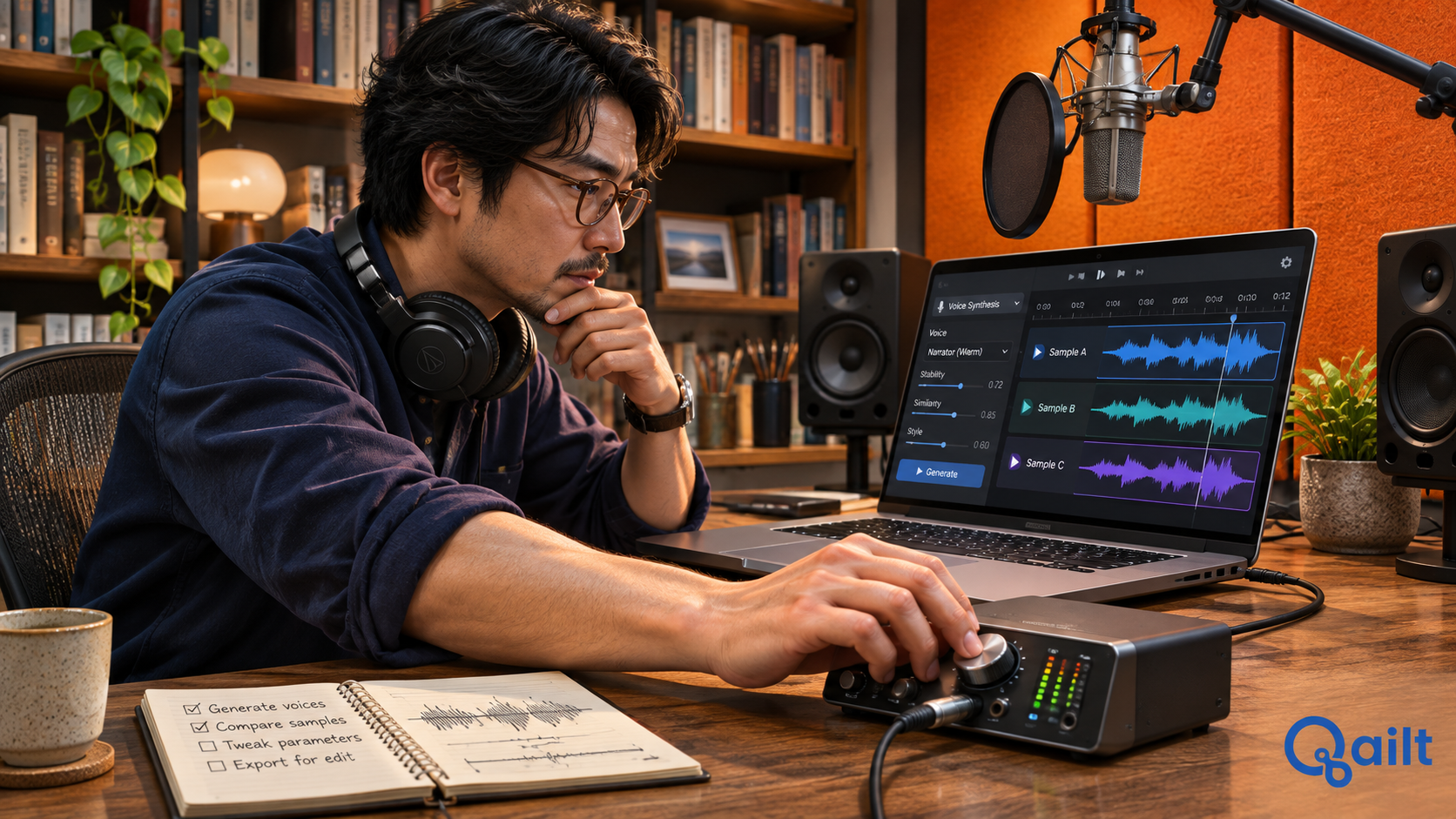
Open alternatives to ElevenLabs are not all ready-to-use applications. Some supply an engine, others downloadable model weights or a Python library. Separate three questions before choosing: does the voice suit the content, do you have the necessary rights, and can you operate the system reliably? Kokoro, Piper and Chatterbox serve different requirements.
Our recommendation: begin with one minute of non-confidential narration on the intended hardware. Do not migrate commercial production because a repository merely carries an “open source” label. Check the exact code, model and voice you would use.
Which project should you try for your requirement?
Important update: according to the official README, Chatterbox was retired in August 2026. The repository remains a public research archive without maintenance or support. Historical variant descriptions and an old commercial link remain farther down the page. Do not interpret them as a current support offering. We do not recommend this archive for a new production workflow requiring maintained software.
| Requirement | Candidate and documented language | Practical route | Decision point |
|---|---|---|---|
| French narration without a reference voice | Kokoro, language code f for fr-fr | Python library, compatible voice and WAV output in the official example | Match language and voice; check dependencies and pronunciation |
| Local engine operated from the command line | Piper, language determined by the selected voice model | Download a voice, then generate with the documented client | Inspect the exact voice card; do not infer blanket commercial permission from the engine |
| Experiment with an authorised reference voice | Chatterbox Multilingual; Turbo and Nano are listed as English | Research archive, not a maintained-service recommendation | Accept responsibility for maintenance and check rights; otherwise exclude it |
This orientation uses the Kokoro instructions, Piper guide and Chatterbox README and warning. It does not compare sound quality or prescribe untested memory requirements.
Open source, open weights and free service are different
Code describes how software works. Weights are the learned model files. Voices, training data and dependencies may have separate conditions. Access to the first component does not establish rights over everything else.
A free service can remain entirely hosted by its supplier. Conversely, a downloadable model may require hardware, technical knowledge and maintenance. In this guide, an open alternative means a system whose components you can inspect or obtain; it is not a uniform certification of the complete training and production chain.
For a managed option without installation, see the ElevenLabs overview or our ElevenLabs versus Murf comparison for French voiceovers. This article instead focuses on deployment and component control.
Three candidates to investigate
| Project | Potential fit | Main check |
|---|---|---|
| Kokoro | Narration with downloadable weights and an inference library | Actual language, voice and installed dependencies |
| Piper | Local engine with a selection of voices | Voice provenance, separate from the engine licence |
| Chatterbox | Several variants and multilingual speech | Correct model, resources and reference-voice permission |
Kokoro: open weights, not a finished production service
The Kokoro-82M model card describes open weights under Apache 2.0. The inference repository also specifies Apache 2.0 and documents languages including French and dependencies such as espeak-ng. Open weights do not establish that every component needed to reproduce training has been provided.
Consider it for controlled narration, then evaluate the exact voice against your vocabulary. A model name or a demonstration selected by its author is not evidence that your own script will sound right.
Piper: engine rights do not settle voice rights
The current licensing documentation specifies GPL-3.0-or-later for the engine and says Piper makes no licence grant over voice models. Inspect the MODEL_CARD and training-data chain of your exact download: an unchanged voice name can cover a retrained version. Do not infer commercial permission from the code repository alone.
The command-line guide describes generation. Technical integration is still necessary if you want a straightforward interface for non-technical writers rather than an engine operated through commands.
Chatterbox: an unmaintained research archive
The Chatterbox README distinguishes Turbo, Nano and Multilingual, with different language coverage and purposes. It documents Python, device selection and French generation using the multilingual variant. Do not generalise a performance claim for one variant to the whole family.
The code uses MIT, and the main model card lists MIT. Still preserve the terms of your selected checkpoint. Imitating an identifiable voice requires appropriate permission; a software licence is not permission to make another person appear to speak.
A practical setup process, not a universal command
Before installing anything, record the operating system, available memory, any graphics hardware and disk capacity. Identify someone who can maintain Python and dependencies. If nobody can explain how to restore a working version, a managed service may remain the cheaper option.
- Open the official repository and model card, not a random installer.
- Select a documented version and preserve its references.
- Prepare an isolated environment rather than changing unrelated projects.
- Install only the dependencies required for your operating system.
- Obtain the chosen model and voice with their notices.
- Generate a short sentence and play the output outside the interface.
These are planning steps, not commands guaranteed to work everywhere. Linux examples cannot simply be pasted into Windows. A first-run model download does not imply that subsequent generation is remote; equally, a local-looking interface can call an online service. Verify the actual route instead of relying on appearance.
Keep the first working configuration unchanged while evaluating it. Record dependency versions and the model revision before upgrading. Otherwise, an improvement or regression may be difficult to explain, and a voice produced next month may not match this month’s delivery.
Keep a repeatable narration test
Prepare roughly one minute of original text containing an introduction, a long sentence, date, amount, acronym and closing line. Include a negative instruction such as “do not close the window”. Dropping a short word can reverse the meaning. Use exactly the same script in every candidate instead of comparing unrelated demos.
Listen without reading first, then with the transcript. Record missing words, incorrect numbers, artificial breaths, clipped endings and volume changes. Next, correct just one sentence and check whether it can be joined to the rest without an obvious change in delivery.
Measure initial loading separately from subsequent generation. Log hardware, software version, output duration and elapsed time. “Fast” is meaningless without that context. For a hundred-paragraph batch, inspect failures and retries as well as the best sample. A system that produces one excellent clip but needs constant intervention may not fit your workflow.
Testing disclosure: QAILT checked official documentation on November 13, 2026. None of these systems was installed or timed for this article. The proposed exercise is not a sound-quality ranking or a guaranteed hardware specification.
Privacy, cost and ongoing operation
Local deployment can reduce text transmission, but inspect logs, synchronisation, monitoring tools and network calls in your actual installation. Begin with fictional material. Do not upload confidential documents to a public demonstration merely to evaluate a voice.
Total cost includes setup, hardware, electricity, storage, updates and review. Calculate the cost per accepted final minute, not merely per generated minute. Include retries and the time of the person fixing problems. Removing a subscription does not remove the operational work.
Decide where scripts and outputs are stored, who can access them and how temporary material is removed. These are deployment choices your team must make. Downloading a model does not automatically provide a retention policy, access controls or a maintained backup process.
When a managed service remains sensible
If use is occasional, deadlines are tight and the team is non-technical, avoid building infrastructure solely to eliminate a small bill. An open alternative becomes worthwhile when deployment control, volume or a specific integration genuinely justifies that effort.
Before commercial delivery, resolve uncertain rights for the particular voice and version. Keep notices, references and permissions with the project. The strongest ElevenLabs replacement is something you can operate, maintain and account for, not merely something you can download. Keep a small approved sample as a reference whenever you change the model, voice or configuration.
Related tools

ElevenLabs
Voice synthesis AI tool designed to generate realistic voices and high-quality voiceovers
Read next
ElevenAI opens early access for meeting notes on Mac
ElevenLabs introduces a Mac app with dictation, speaker-labeled transcripts, and action items. Free early access is available by sign-up.
Best AI tools for dubbing videos in French and English
ElevenLabs, HeyGen or YouTube: compare translation, correction and synchronization to dub French and English videos without changing meaning.
ElevenLabs vs Murf for French Voiceovers
Compare ElevenLabs and Murf for French narration, pronunciation fixes, audio downloads and syncing a voiceover to video.