
Best AI tools for creating quizzes from course notes
Choose Gemini Notebook for source-based work, Quizlet for structured revision, or ChatGPT Study Mode for step-by-step questioning. Learn what to check before trusting the answers.
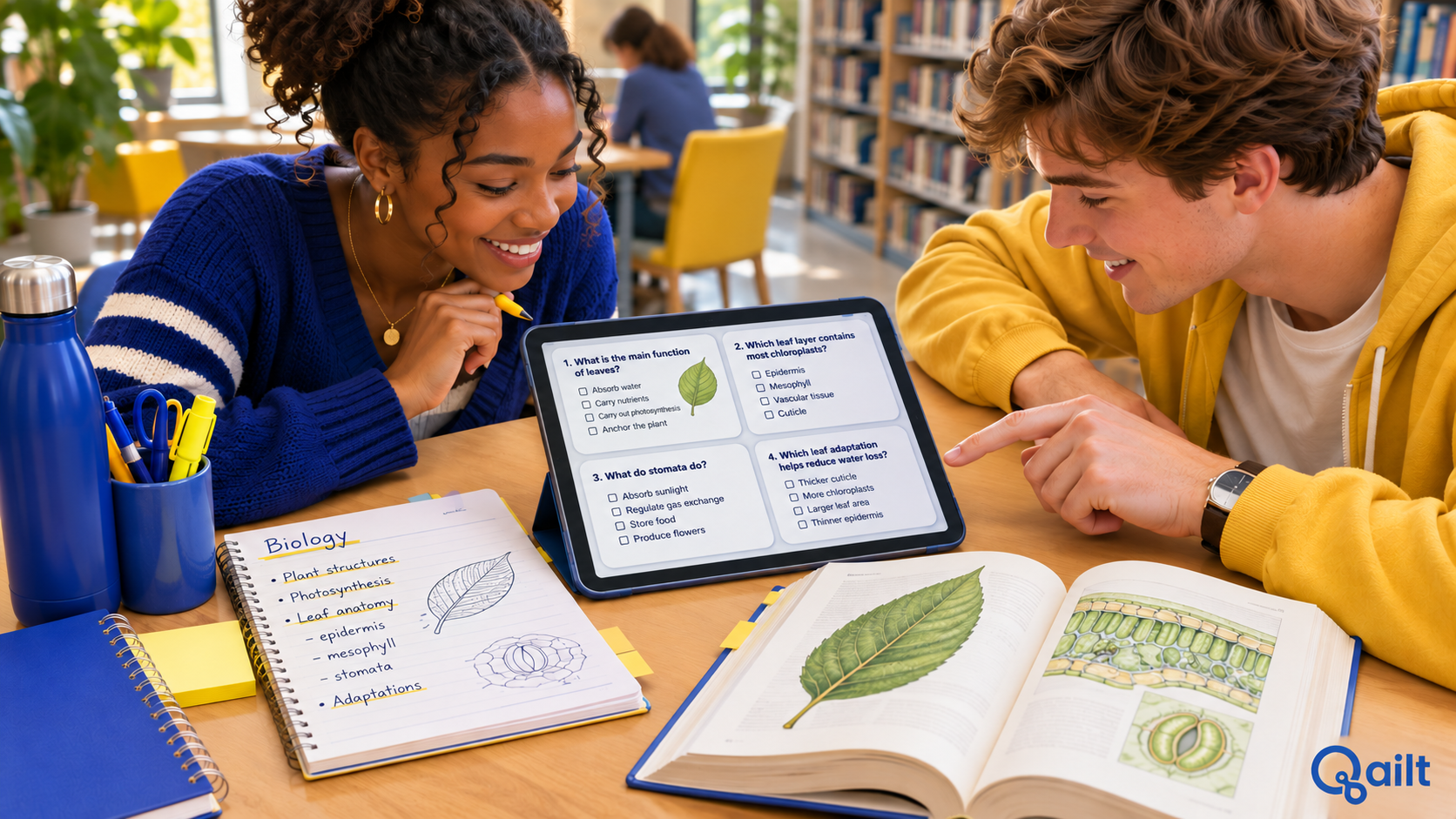
Choose Gemini Notebook to build quizzes from a collection of course sources, Quizlet to turn notes into revision materials or practice exams, and ChatGPT Study Mode for questions followed by feedback in a conversation. These are recommendations based on documentation, not comparative product tests. If you need justified answers, the decisive criterion is whether you can trace each correction back to your notes, preserve their exceptions and identify what they do not say.
The three tools serve different needs. An automatically generated quiz is not the same as a tutoring conversation, and a plausible explanation is not evidence from your course. The practical approach is to choose the right workflow, then check the output with a small, reproducible exercise.
What matters when choosing a quiz generator
Fidelity matters more than volume. Questions should stay within the course material and preserve its conditions and exceptions. A useful answer key should let you find the relevant passage, distinguish an explicit statement from an inference and recognize missing information. Asking for a page or paragraph is a checking method, not a guarantee that the tool will provide an accurate reference.
Next, inspect the explanation: does it show why the answer is correct and why the other options are wrong? For difficulty, distinguish simple recall, application of a rule and reasoning across several passages. Finally, decide whether you want successive questions, flashcards or a complete practice test. Those formats support different working routines and should not be treated as interchangeable.
Gemini Notebook: prioritize the connection to sources
Gemini Notebook, formerly NotebookLM, uses the name introduced in Google’s announcement. It suits a workflow built around a collection of course materials.
It accepts PDFs, websites, YouTube videos, audio, Docs and Slides. Chat answers can include citations; access depends on account, country and age requirements, according to Google’s access and source guidance.
In Studio, users with editing permission can create quizzes or flashcards, customize difficulty and instructions, view explanations and retry. Documented CSV downloading applies to flashcards: see the quiz and flashcard features.
To assess the output, isolate a question whose answer depends on an exception, then check the relevant passage. Citations available in chat do not guarantee a reference in every quiz explanation; flashcard export does not establish questionnaire export. Check those capabilities separately.
Quizlet: separate study guides from practice exams
Study Guides turn notes into outlines and editable flashcards. They are documented in English, French and German, with limited free access, unlimited access for Plus and Unlimited, and a minimum age of 18 in France.
AI Practice Tests, separate from Test mode, create exams from notes or cards: question count, type and duration are configurable, followed by scoring and review. Documented access requires an English configuration, is limited for free users and also starts at age 18 in France.
Choose the output first: cards to revisit or an exam to complete. French-language Study Guides do not establish Practice Tests availability in the same language. Likewise, adding questions does not necessarily require harder reasoning. To assess difficulty, ask for a rule-application question and then one combining two passages, and check the answer key yourself.
ChatGPT Study Mode: prioritize a step-by-step conversation
ChatGPT Study Mode can ask successive questions, wait for an answer and provide feedback using attached files where uploading is available. It operates in ordinary chats, outside Temporary Chats, GPTs and Projects. Account limits still apply; it can make mistakes or reveal an answer directly.
A conversation lets you make a precise request: “Is my answer supported by paragraph 3? Which condition did I miss?” The useful check concerns the reasoning, not just a right-or-wrong label. Our ChatGPT profile provides broader context; keep your course material open to check each correction.
Match the tool to the task
- Finding supporting evidence: favor Gemini Notebook for its source-citing chat, without automatically attributing that capability to every quiz correction.
- Organizing notes in French: consider Quizlet Study Guides; for configurable practice exams, assess Practice Tests separately and account for their documented English configuration.
- Explaining your reasoning: favor Study Mode and request one question at a time, with justification after your answer.
Before a study session, check the feature in your account and prepare a short excerpt first. Access requirements can depend on country, age and plan. Our Top 10 AI tools for students places this choice alongside other study tasks.
A proposed exercise: check before you revise
This original QAILT exercise is fictional and proposed for readers to carry out. No product trial has been performed. Copy the passage first, keeping the reference answer key separate so you can check the output yourself.
Reference passage: fictional Orion Library
§1: it opens Monday to Friday, 8 am to 6 pm.
§2: a member may borrow up to three items for fourteen days.
§3: a loan may be renewed once for seven days if no other member has reserved the item.
§4: dictionaries must remain on site and are never lent out.
§5: registration requires a completed form and proof of identity. The registration fee is not stated in this passage.
A copyable prompt for your own course
Using only the supplied course material, create five revision questions combining recall, application and reasoning across rules. In conversational mode, ask one question at a time and wait for my answer before showing the correction. Justify each correction with the relevant paragraph or page, without inventing references. For each multiple-choice question, provide exactly one correct answer and explain why the distractors are wrong. Preserve exceptions and flag missing information. Do not add outside knowledge.
For help framing the request, see how to write a good prompt with ChatGPT. In an automatic quiz interface, adapt these requirements to the options actually available. Do not assume it can wait conversationally before every correction or accept every requested setting.
Control questions and separate reference answer key
- What is the maximum number of items on loan? Three (§2).
- Can you take a dictionary home? No, it must remain on site (§4), despite the general rule in §2.
- What is the maximum total duration with the single permitted renewal? Twenty-one days, or 14 + 7, provided nobody has reserved the item (§2–3).
- What is the registration fee? Not specified (§5). Neither “free” nor a monetary amount is supported.
- Another member has reserved the item: can you renew it? No (§3).
Check that a multiple-choice question requested to have one correct answer does not admit two, that the dictionary exception survives and that the fee remains unknown. Polished wording does not compensate for a missing condition.
Finish without AI by answering a new question: “A member wants to take a dictionary and two other items home for fourteen days: how would you explain what is allowed?” Build your explanation from the relevant paragraphs. The point is to check what you can explain independently, not to claim a measured improvement in learning.
Put it into practice

Related tools

ChatGPT
Versatile AI assistant to search, write, analyze and automate many everyday tasks
Read next
Top 10 AI tools for students: study, research and prepare your work
Ten AI tools for understanding course material, checking sources, revising and preparing student work, with a practical use and a limitation for each.

AI for Productivity: Simple Ways to Save Time Every Day
Explore simple ways to use AI to organize work, summarize information, and save time daily.

Using AI for content creation
Discover how AI tools can help you create text, visuals, videos, and content ideas faster.