
Synthesia alternatives for avatar-based training videos
Compare HeyGen and Colossyan as Synthesia alternatives: avatars, updates, interaction and LMS delivery, with a practical pilot before switching.
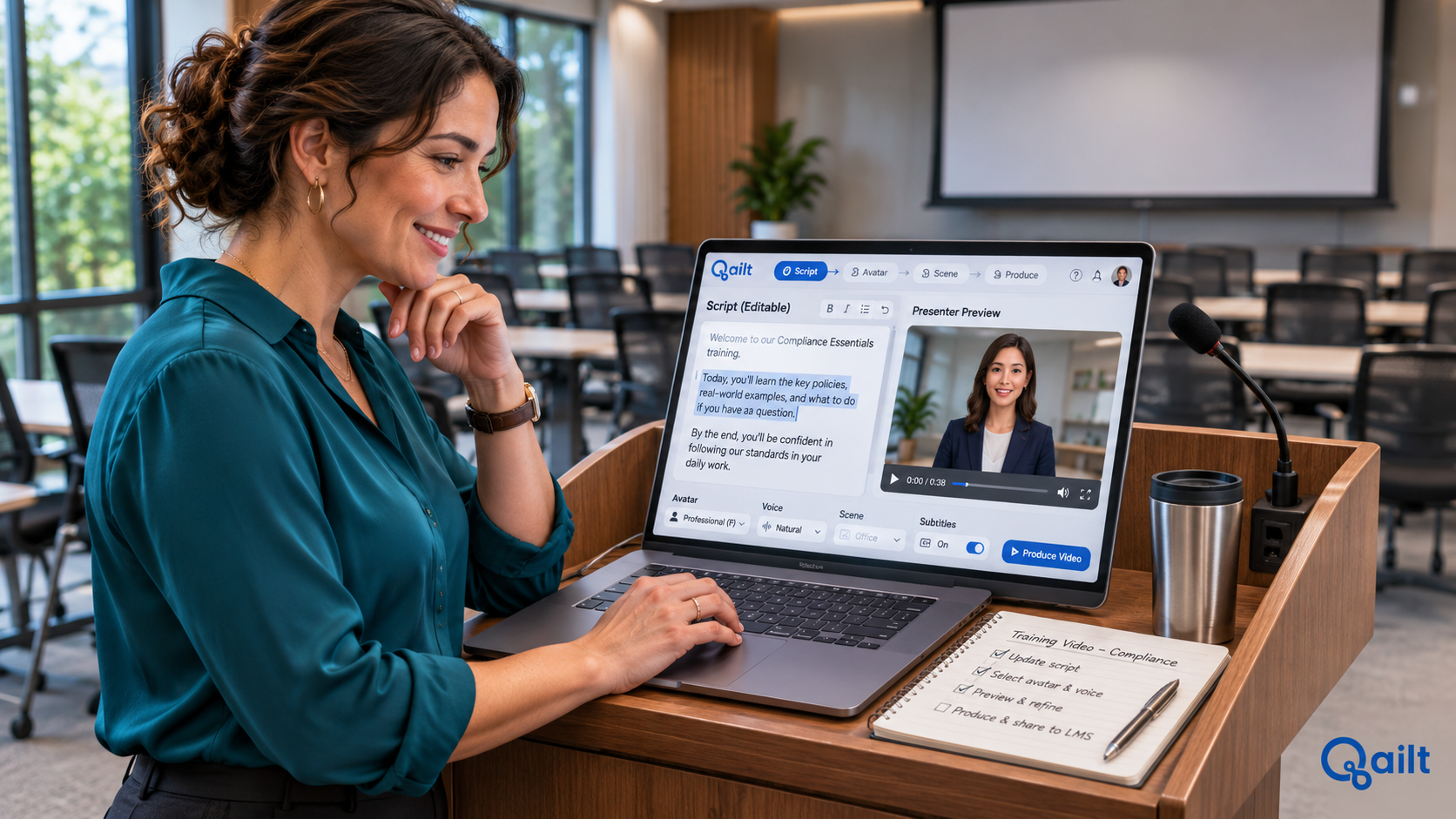
When replacing Synthesia for avatar-based training, look beyond the first attractive video. Procedures change, translations need corrections and learners leave a module halfway through. Your alternative must support those situations, not just display a convincing presenter. This shortlist examines HeyGen for video lessons with viewing completion and Colossyan for interactive learning scenarios. These are candidates to evaluate, not winners from a measured avatar-realism contest.
Short answer: compare the cost of a corrected lesson delivered in your learning platform, rather than the advertised price of a generated minute. An MP4 file and a tracked learning module are different deliverables.
Define what you actually need to replace
List the outputs you use today: video, captions, language versions, questions, completion records and editable source material. Count the people who write, approve and publish. A small team shipping three internal videos needs a different workflow from a training department maintaining a hundred multilingual modules.
Use the Synthesia overview as a reference, alongside our HeyGen versus Synthesia guide for French training. This article broadens the decision to maintenance and delivery. Neither guide replaces listening to your own specialist terminology in the target language.
Two alternatives with different priorities
| Main requirement | Candidate | Critical check |
|---|---|---|
| Present a video lesson and record viewing completion | HeyGen | SCORM access and update behaviour on the chosen plan |
| Ask learners to choose a route or answer questions | Colossyan | Whether interaction survives the intended delivery format |
| Deliver a straightforward offline film | Compare the same MP4 sample | Clarity, voice, captions and rights without unnecessary LMS features |
HeyGen: investigate the video-to-LMS workflow
HeyGen offers script-based avatar videos. It offers both ready-made presenters and personal avatars created with verified permission. That capability does not give you permission to reproduce any employee: agree the intended use before creating a personal likeness.
HeyGen offers SCORM exports on Business and Enterprise, with support for SCORM 1.2 and 2004, a viewing threshold for completion and an automatic-update option. This makes HeyGen worth investigating for a maintained video library. Watching a percentage of a video, however, is not proof that someone has acquired the skill.
Colossyan: evaluate the learning scenario
Colossyan combines AI presenters with training features. It supports multiple-choice questions and branching. The delivery distinction matters: interactive videos cannot be exported as MP4. Links, embeds and eligible SCORM exports serve different purposes from a downloaded linear film.
Colossyan offers SCORM exports on Professional and Enterprise, with five shared monthly exports on Professional and a separate allowance for Learn courses. Check the relevant counter before committing to recurring multilingual delivery. Do not assume that video and course product allowances are interchangeable.
Use one three-scene pilot
Prepare a fictional procedure without customer information: receive a request, check two details and direct the person to the right team. Use three scenes lasting roughly a minute overall. The first introduces the objective, the second demonstrates the action with a screenshot, and the third asks the learner to choose what happens next. Keep the script and visual assets identical across trials.
Include an acronym, a product name and an important negative instruction. Ask a colleague who understands the subject to identify mistakes without knowing your preferred supplier. Score pronunciation, displayed text, understanding of the action and distracting visual behaviour separately. A pleasant voice can read the wrong number; accurate lip movement cannot repair incorrect instructions.
Testing disclosure: this is a proposed evaluation exercise. QAILT did not generate or time these two product trials for this article.
The overlooked test: update the published lesson
Once the initial pilot passes review, deliberately change an instruction in the second scene. Record how long it takes to find the project, edit the script, regenerate the output, review captions and publish again. Check the other language separately. Updating a French script does not mean the English translation has been approved.
Keep a simple change log with module identifier, version, language, date, approver and a description of the correction. Preserve the earlier delivery. If a hosted link updates automatically, consider how you will establish which version a learner saw yesterday. Fast updates are useful, but they are not a replacement for version records.
Assign ownership of each lesson rather than relying on whoever last edited it. Otherwise a colleague can correct the source procedure while the training video remains unchanged. Your maintenance checklist should connect the business document, script, translations and final learning module.
Check delivery before buying for the entire team
SCORM is a format for exchanging learning content with a learning management system, or LMS. It does not guarantee that every platform interprets every option identically. Import a small module into a test area of your actual LMS. Use a learner account, not only the administrator preview.
- Start the lesson, leave halfway through and return.
- Check mobile display and captions.
- Stop below the intended completion threshold, then complete enough content.
- Inspect the recorded status and answers where applicable.
- Update a scene and check what a new learner receives.
Do not treat viewing completion as the same thing as passing a knowledge check. Decide what evidence you need before selecting the format. An internal announcement might need only a video and reference sheet; a skills assessment requires a tested success rule. Run the pilot through the same browser and access route your learners will use.
Budget for maintenance, not just generation
Model a representative month: for example, ten initial lessons, two languages and three corrections. Those numbers are planning assumptions, not supplier price estimates. Include editor access, repeated generations, required exports, language review and LMS integration. A low entry price means little if the delivery feature requires another plan.
Ask what happens when an allowance is exhausted and when the subscription ends. Can you retain final files, retrieve scripts and keep previously delivered modules working? Obtain answers for the offer you would actually buy. A small subscription difference can matter less than hours spent rebuilding missing source material.
Also price the approval process. Someone must verify instructions, listen to the voice and check that the on-screen demonstration matches the words. Budgeting zero review time because an avatar reads the script automatically is not a realistic production plan.
A practical decision rule
Start with HeyGen if your priority is a maintainable video lesson with viewing completion. Start with Colossyan if learner choices and integrated questions shape the lesson. Keep Synthesia if neither alternative solves a measurable problem: switching adds migration work and team training.
Whichever route you choose, provide an accessible transcript and human subject review. An avatar presents the explanation; it is not the responsible expert or evidence of accuracy. The strongest replacement helps your team deliver correct instructions, amend them quickly and verify what learners actually received.
Related tools

Synthesia
Video generation AI tool designed to create videos with virtual avatars from text
Read next
HeyGen vs Synthesia for French Training Videos
Compare HeyGen and Synthesia for French training videos, from PowerPoint and PDF import to voice corrections, subtitles and LMS tracking.

AI for Small Businesses: Where to Start
A practical guide for small businesses that want to start using AI without overcomplicating things.
ElevenAI opens early access for meeting notes on Mac
ElevenLabs introduces a Mac app with dictation, speaker-labeled transcripts, and action items. Free early access is available by sign-up.